
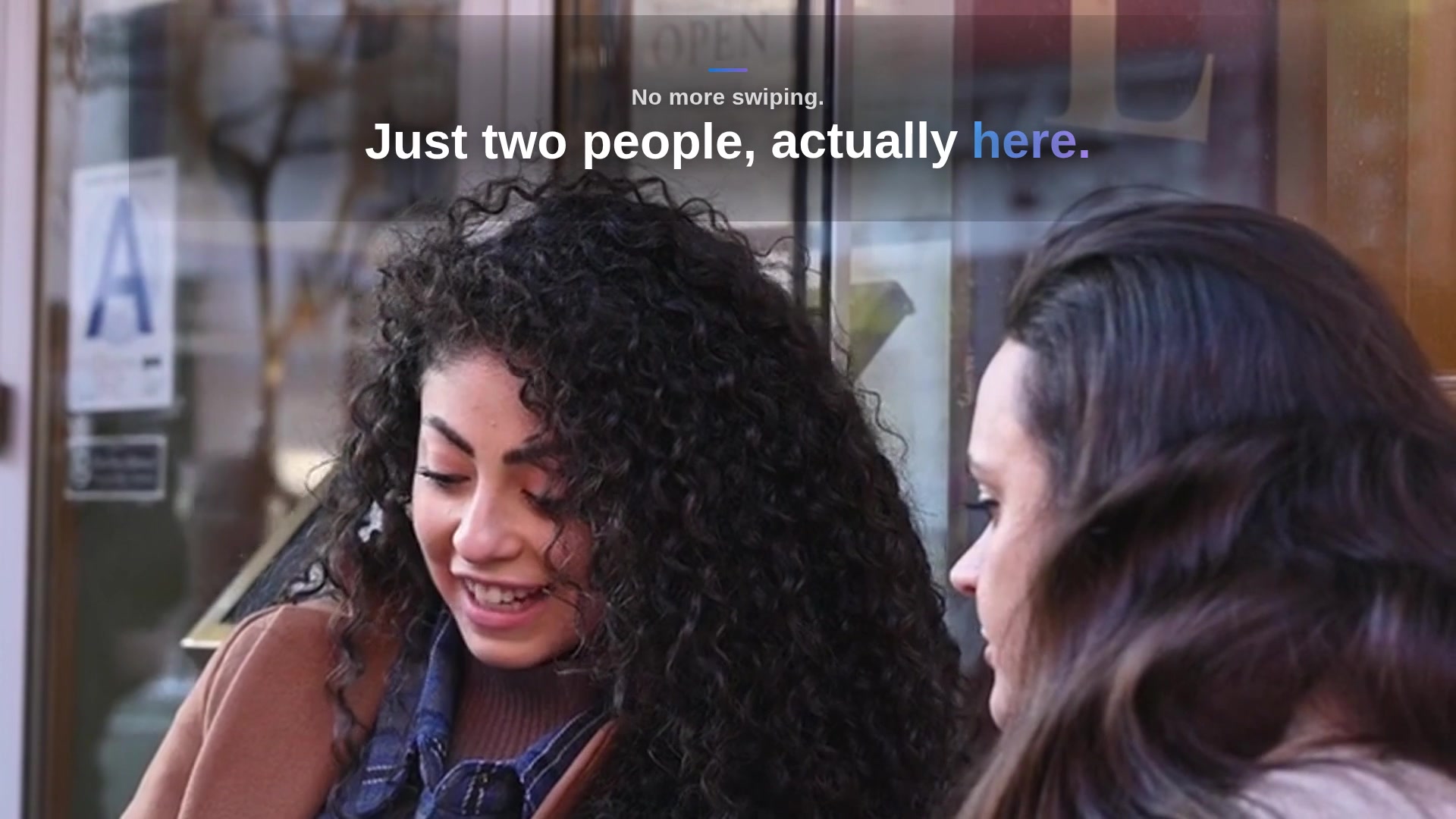
Most dating apps are built on a simple, quietly broken premise: that the person you should meet is somewhere out there, across a whole city, waiting to be discovered through a deck of cards. You swipe, you match, you schedule, and days later — if you're lucky — you meet a stranger who has to travel to be near you.
We think that's backwards. The most promising version of a night isn't a match sitting forty minutes away who you'll message for a week before either of you commits to a plan. It's the person two tables over, at the same show, in the same line for the same coffee shop — already close enough that meeting doesn't require a project plan.
The swipe was never the point
Swiping was a clever way to sort a huge, undifferentiated pool of strangers quickly. It made sense when the alternative was scrolling a static list. But it also trained an entire generation to treat meeting people as a feed to consume rather than a room to walk into — and the fatigue that's followed makes sense in hindsight. A feed never runs out, which means it never resolves. You can swipe for an hour and end exactly where you started: nobody met, no plans made, just more profiles seen.
It's telling that even the biggest dating apps have spent the last year or two quietly building toward the same conclusion — adding in-person events, meetups, and IRL features on top of the swipe. That's a tell. When the platforms built around infinite matching start bolting on real-world gatherings, the swipe itself was never the destination. It was a workaround for not having a better way to show you who's actually around.
What changes when the room is the feed
VYB doesn't ask you to sort a deck of strangers spread across a metro area. Check in, and your "feed" becomes the actual room you're standing in — the people who are there, verified, right now. There's no infinite scroll to get through, because there's nothing infinite about a room. It has an edge. You can see the whole thing.
That's a small design choice with a large consequence: it turns "meeting people" back into something that happens in a place, at a time, with a person you could walk over to in ten seconds — instead of a logistics problem you solve over days of texting someone who might live across town. Dating apps didn't invent meeting people. They just got between you and the room. We'd rather get out of the way.